Goblet Squat
A foundational movement for mastering squat mechanics, building lower-body strength, and enhancing core stability.
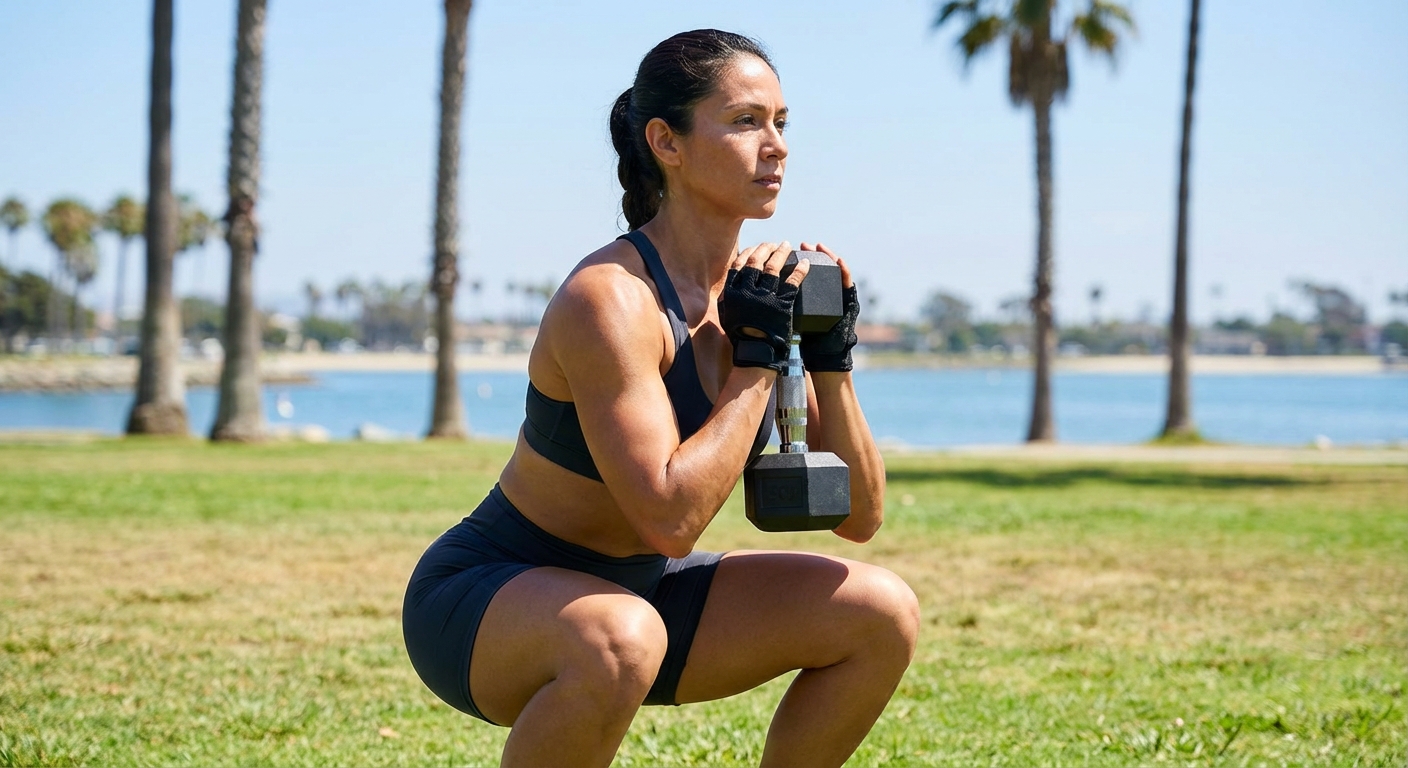
The anterior load promotes an upright torso and deep, controlled range of motion.
Biomechanical Analysis
1 Kinetic Chain & Force Generation
The goblet squat is a closed kinetic chain, multi-joint movement. Force is generated primarily through concentric and eccentric contractions of the lower body's major extensors.
- Primary Drivers: Quadriceps (knee extension torque) and Gluteus Maximus (hip extension torque).
- Key Synergist: Adductor Magnus acts as a powerful hip extensor, especially in the bottom position.
- Stabilizing Role: The upper extremities and core musculature provide vital isometric stabilization to support the anterior load, creating a full-body training effect.
2 Pivot Points & Moment Arms (τ)
Movement is governed by concurrent action at the hip, knee, and ankle (talocrural) joints. The anterior load fundamentally alters joint kinetics.
The load held in front of the chest shifts the body's center of mass (COM) forward. This requires a more upright torso (decreased trunk inclination angle θ), which changes the moment arm (τ = r × F) for each joint:
- Increased Knee Moment: The more vertical tibia increases the perpendicular distance from the knee joint to the load's line of force, raising the knee flexion moment. This places greater emphasis on the quadriceps.
- Decreased Hip Moment: The upright torso shortens the hip's moment arm, reducing the hip flexion moment compared to a back squat.
3 Dynamic Stabilization
The anterior load creates unique stability demands that engage the entire musculature in an isometric or synergistic capacity.
- Spinal Anti-Flexion: The weight pulls the torso forward, creating a flexor torque on the spine. This is counteracted by robust isometric contraction of the erector spinae and deep core (transversus abdominis).
- Frontal Plane Knee Stability: Controlled descent requires the gluteus medius and minimus (hip abductors) to fire dynamically, preventing knee valgus (inward collapse).
- Scapular Fixation: The latissimus dorsi, rhomboids, and rear deltoids work to retract and depress the scapulae, creating a stable "shelf" to hold the weight.
Muscle Engagement Map
The goblet squat is a compound movement that integrates muscle groups across the entire kinetic chain. Muscles engaged are shown in the diagram above.
Primary Movers
These muscles are responsible for the primary joint actions of the lift.
- • Quadriceps Femoris
- • Gluteus Maximus
- • Adductor Magnus
Function: Generate concentric force for ascent and control eccentric descent.
Secondary Movers & Synergists
These muscles assist the prime movers and contribute to the movement pattern.
- • Soleus & Gastrocnemius
- • Hamstrings (Biceps Femoris, Semitendinosus, Semimembranosus)
- • Erector Spinae
Function: Assist in ankle plantarflexion, hip extension, and spinal stabilization.
Dynamic Stabilizers
These muscles work isometrically or dynamically to maintain posture and joint integrity.
- • Core Musculature (Transversus Abdominis, Rectus Abdominis)
- • Gluteus Medius & Minimus
- • Latissimus Dorsi, Rhomboids, Trapezius
Function: Resist spinal flexion, prevent knee valgus, and stabilize the scapulae.
Execution Protocol
Follow this step-by-step protocol to perform the goblet squat with optimal technique, maximizing safety and effectiveness. This sequence is designed for use with a daily warm-up timer.
Step-by-Step Technique
-
1
Setup & Grip
Hold a dumbbell or kettlebell vertically against your chest. Cup the top weight plate or the horns of the kettlebell with both hands. Position your elbows pointing down, tucked close to your ribs. Stand with feet shoulder-width apart, toes slightly turned out (≈ 15°).
-
2
Brace & Initiate Descent
Take a deep diaphragmatic breath and brace your core as if preparing for a punch. Simultaneously initiate the movement by pushing your hips back and bending your knees. Keep your chest up and proud, maintaining a neutral spine. Ensure your knees track in line with your toes.
-
3
Achieve Depth
Descend under control until your hips drop below the level of your knees (full depth) or as far as your mobility allows while maintaining form. The weight should remain centered over your mid-foot. Your elbows should come inside your knees, which helps maintain an upright torso.
-
4
Drive & Ascend
Do not pause or bounce at the bottom. Drive through your entire foot, focusing on pushing the floor away. Lead with your chest, keeping it upright. Extend your hips and knees simultaneously. Maintain full-body tension, squeezing your glutes forcefully at the top to achieve full hip extension.
-
5
Reset & Repeat
At the top, exhale and re-brace before the next repetition. Ensure you have full control before initiating the next descent. Focus on maintaining consistent tempo and form throughout the entire set.
Common Technique Errors & Corrections
| Mistake | Biomechanical Consequence | Coach's Correction |
|---|---|---|
| Excessive Forward Lean | Shifts load posteriorly, increasing shear forces on the lumbar spine and reducing quadriceps engagement. Defeats the primary mechanical advantage of the goblet position. | Cue: "Chest up, elbows down." Imagine keeping the weight directly over your arch. Use a mirror to monitor torso angle. |
| Knee Valgus (Inward Collapse) | Places excessive stress on the medial collateral ligament (MCL) and patellofemoral joint. Indicates weak hip abductors and external rotators. | Cue: "Screw your feet into the floor" or "Spread the floor with your feet." Actively push knees outward in line with toes throughout the movement. |
| Heels Rising Off Floor | Indicates poor ankle dorsiflexion mobility or improper weight distribution. Shifts load to the forefoot, reducing power output and stability. | Cue: "Weight in your heels." Perform ankle mobility drills. Consider elevating heels slightly with small weight plates if mobility is limited. |
| Losing Core & Upper Back Tension | Allows the weight to pull the torso into flexion, increasing spinal compression and reducing efficiency of force transfer from lower body. | Cue: "Crush the weight" and "Big belly breath, then brace." Before descending, actively pull the weight apart (isometrically) and tighten your lats. |
| Incomplete Range of Motion | Limits muscular development, particularly of the glutes and adductors which are most engaged at depth. Reinforces mobility restrictions. | Cue: "Hips below knees." Use a target (e.g., a box or bench) to touch lightly with your glutes. Prioritize depth over load. |