Biomechanics Deep Dive
Kinetic Chain
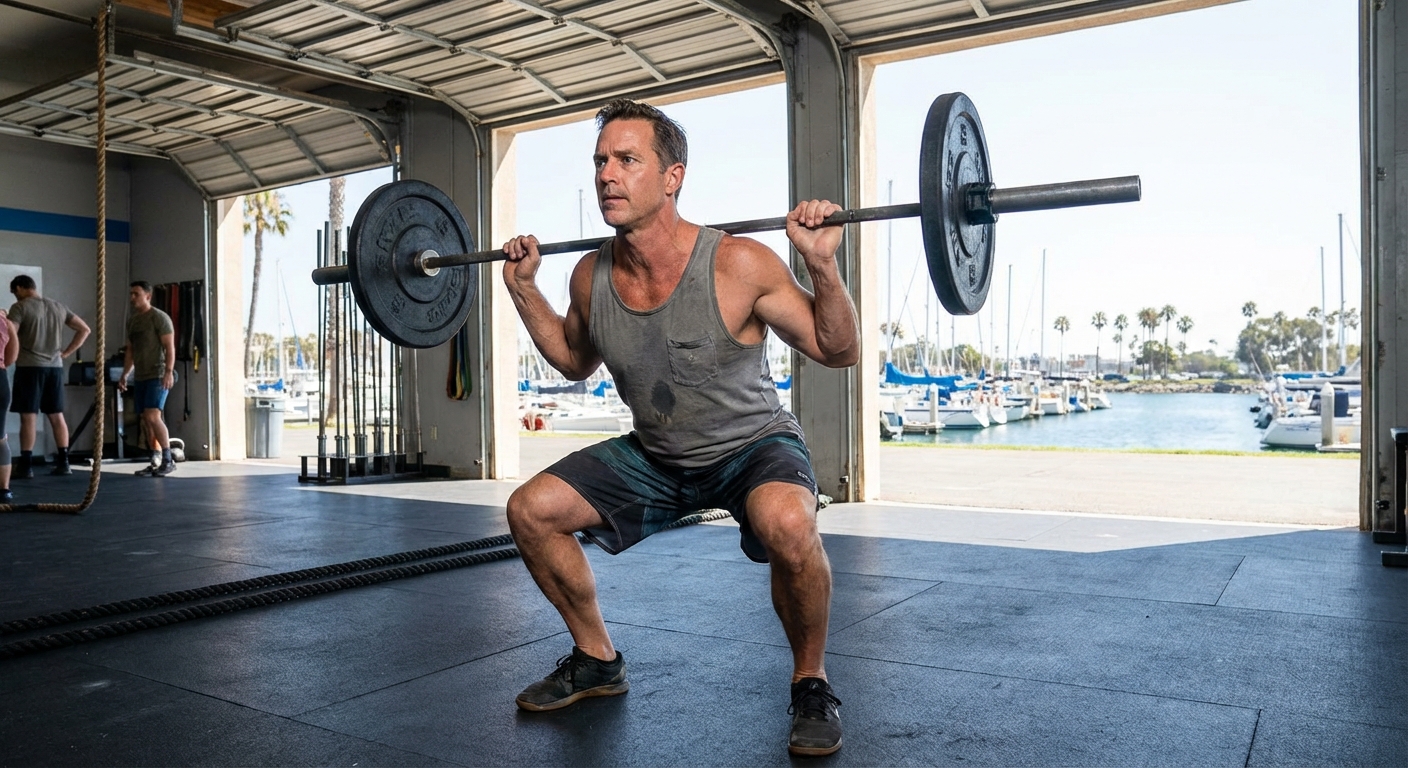
The barbell squat is a closed kinetic chain, multi-joint compound movement driven by the hip extensor, knee extensor, and ankle plantarflexor complexes. Power transfers proximally from the lumbo-pelvic-hip complex down to the feet, generating ground reaction forces that travel axially back up the spine.
Pivot Points
Primary rotational axes include the acetabulofemoral joint (requiring ~120° of hip flexion), the tibiofemoral joint (undergoing substantial shear and compressive forces at ~110° to 130° of knee flexion), and the talocrural joint (requiring at least 15°-20° of ankle dorsiflexion). Joint moment arms (τ = r × F) dynamically shift between hips and knees based on torso inclination.
Stabilization Need
The axial skeleton demands rigorous intra-abdominal pressure to maintain spinal neutrality (lumbar flexion θ ~ 0°). This requires isometric co-contraction of the erector spinae, rectus abdominis, and obliques, alongside active latissimus dorsi engagement to lock the barbell tightly against the upper back.
Muscle Map
Primary Movers
Quadriceps Femoris (Vastus Lateralis, Vastus Medialis, Vastus Intermedius, Rectus Femoris), Gluteus Maximus.
Secondary Movers
Adductor Magnus (ischial fibers), Hamstring Complex (Biceps Femoris, Semitendinosus, Semimembranosus), Soleus, Gastrocnemius.
Isometric Stabilizers
Erector Spinae, Transversus Abdominis, Obliques, Rectus Abdominis, Latissimus Dorsi, Rhomboids.
Execution Protocol
- 1 Position the barbell securely across the upper trapezius (high bar) or posterior deltoids (low bar), actively retract the scapulae, and unrack the weight using both legs.
- 2 Take one to two controlled, deliberate steps backward. Establish a shoulder-width stance with the feet externally rotated roughly 15° to 30°, rooting the mid-foot into the floor.
- 3 Take a deep diaphragmatic breath, expand the abdomen 360 degrees against a lifting belt (if worn) to generate maximal intra-abdominal pressure, and brace the core vigorously.
- 4 Initiate the eccentric descent by simultaneously unlocking the hips and knees. Allow the knees to track directly over the toes while keeping the spinal angle neutral (θ ~ 0° of relative flexion).
- 5 Descend until the crease of the hip breaks the horizontal plane of the top of the patella (optimal depth), ensuring the barbell path remains vertically aligned over the mid-foot.
- 6 Drive forcefully upward during the concentric phase by extending the knees and hips simultaneously. Keep the chest elevated, exhale forcefully near the lockout, and repeat.
Common Mistakes & Corrections
| Mistake | Biomechanical Consequence | Clinical Correction |
|---|---|---|
| Knee Valgus (Collapse) | Excessive shear force on the medial collateral ligament (MCL) and increased patellofemoral friction. | Actively engage the gluteus medius by cuing "spread the floor" or driving the knees outward over the lateral toes. |
| "Good Morning" Squat | Hips rise significantly faster than the shoulders, exponentially increasing the moment arm (τ) and shear force on the lumbar spine. | Strengthen the quadriceps relative to the posterior chain. Cue "chest up" and drive the upper back into the bar out of the hole. |
| Posterior Pelvic Tilt ("Butt Wink") | Loss of lumbar lordosis at maximum depth subjects intervertebral discs to asymmetrical compressive loading. | Squat only to the depth where a neutral spine is maintainable. Improve hip and talocrural mobility prior to increasing range of motion. |
| Inadequate Depth | Fails to optimally recruit the gluteus maximus and vastus medialis obliquus (VMO); increases relative patellar stress on braking. | Decrease the load. Utilize box squats to build spatial awareness of correct depth while continuously mobilizing the ankle complex. |