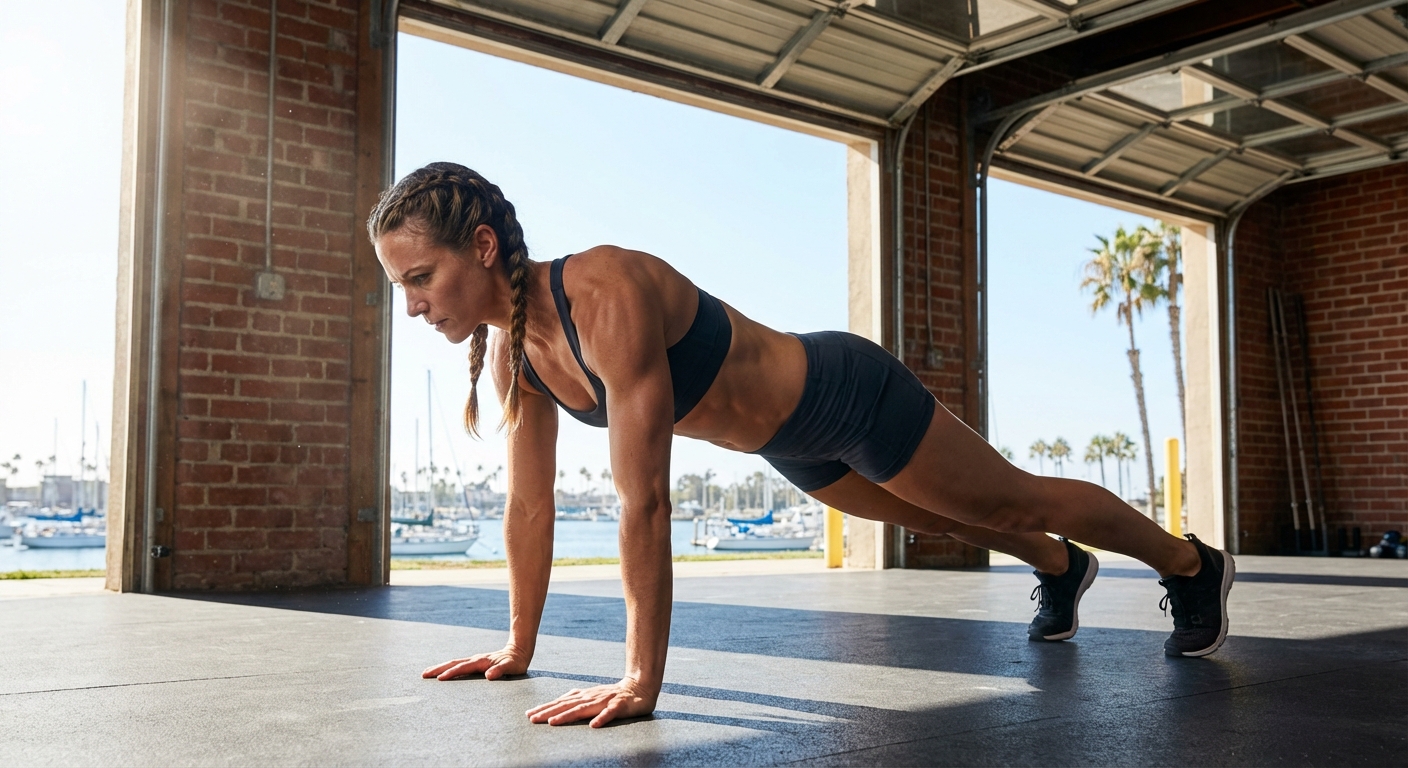
Scapular Push Up
A clinical masterclass in isolated scapulothoracic control. This targeted protocol fortifies the serratus anterior, enhancing glenohumeral stability and optimizing upper-extremity force transmission.
Biomechanical Analysis
Kinetic Chain
Functions as a strict Closed Kinetic Chain (CKC) movement. The distal segments (hands) are rigidly fixed against the floor, causing the proximal segment (thorax) to move relative to the scapulae. Optimal execution requires uninterrupted force transmission from the ground, through the radius, ulna, and humerus, directly into the axial skeleton.
Leverage & Pivots
The primary action is the gliding of the scapulothoracic articulation (protraction/retraction), supported by accessory rotations at the sternoclavicular and acromioclavicular joints. Mechanically, the body acts as a second-class lever pivoting at the metatarsophalangeal joints. Resistance force (F = m × g) acts vertically downward through the system's center of mass.
Torque & Stabilization
Demands absolute isometric extension of the elbows (θ = 180°). The lumbopelvic complex requires substantial anti-extension torque (τ) to maintain a neutral alignment (0° sagittal deviation). Concurrently, the glenohumeral joint relies on the rotator cuff for dynamic centering of the humeral head against shear forces.
Anatomical Muscle Map
Primary Movers
- Serratus Anterior Drives scapular protraction and holds the medial border flush against the thoracic wall.
- Rhomboids (Major & Minor) Agonists during eccentric yielding and concentric retraction of the scapulae.
- Middle Trapezius Works synergistically with the rhomboids to draw the shoulder blades toward the midline.
Secondary Movers
Pectoralis Minor: Assists in anterior tilt and protraction.
Levator Scapulae: Aids in stabilization and elevation control during movement.
Crucial Stabilizers
Triceps Brachii: Maintains rigid isometric extension (θ = 180°).
Core Complex: Rectus abdominis, obliques, transversus abdominis, and gluteus maximus generate anti-extension torque to preserve spinal neutrality.
Execution Protocol
-
1
Assume the Strict High Plank
Position your hands directly beneath your shoulders with fingers spread wide. Lock your elbows into full absolute extension (θ = 180°) and actively grip the floor.
-
2
Establish Core Rigidity
Engage your gluteus maximus and anterior core complex to establish a rigid lumbopelvic unit. Ensure zero sagittal deviation (0°) in your spinal alignment.
-
3
Eccentric Retraction
Keeping the elbows completely straight, slowly pinch your shoulder blades together. Allow your thoracic spine and chest to sink downward in a controlled manner.
-
4
Concentric Protraction
Upon reaching maximum pain-free retraction, forcefully press the floor away. Drive your mid-back directly toward the ceiling, actively spreading the scapulae wide around the rib cage.
-
5
Isometric Peak Hold
Hold the peak protracted (top) position for a strict 1-second isometric contraction to maximize serratus anterior recruitment before smoothly transitioning into the next repetition.
Common Pathomechanics & Corrections
| Biomechanical Error | Physiological Consequence | Clinical Correction |
|---|---|---|
| Bending the Elbows | Shifts mechanical load away from the scapulothoracic joint, inappropriately loading the triceps and pectoralis major. | Consciously lock elbows (θ = 180°). Cue "squeeze the triceps" throughout the entire set. |
| Lumbar Sag (Extension) | Compromises proximal force transmission and places high sheer stress on the lumbar facets. | Co-contract the glutes and abdominals aggressively. Think of your body as a single cast-iron rod. |
| Cervical Hyperextension | Strains deep neck stabilizers and disrupts the alignment of the axial skeleton, altering neuromuscular signaling. | Maintain a subtly tucked chin with a neutral gaze directed straight down at the floor. |
| Excessive Momentum | Reduces essential time under tension (TUT) and bypasses critical motor learning and muscle activation phases. | Implement a clinical 2-1-2-1 tempo (2s eccentric, 1s hold, 2s concentric, 1s hold). |