Bodyweight Squat
The fundamental human movement pattern for lower body strength, mobility, and functional capacity.
Movement Foundation
The bodyweight squat is a closed kinetic chain, multi-joint exercise that serves as the cornerstone of lower body training. It demands and develops strength, balance, proprioception, and core stability.
Mastering this fundamental pattern is essential for athletic performance, injury prevention, and maintaining functional independence throughout life.
Key Metric
Primary Plane of Motion: Sagittal plane, with critical stabilization in the frontal and transverse planes.

Biomechanics Deep Dive
Kinetic Chain & Torque
A closed kinetic chain movement where ground reaction forces travel up through the skeletal system. The descent phase involves simultaneous triple flexion (hip, knee, ankle), storing elastic energy.
The ascent is driven by triple extension. The external moment arm (horizontal distance from the joint center to the body's center of mass line of force) creates the resistive torque (τ = F × r) that the muscles must overcome.
Joint Pivots & Force Vectors
Rotation occurs around three primary axes:
- Hip (Acetabulofemoral): Flexion/extension in the sagittal plane.
- Knee (Tibiofemoral): Primary sagittal plane motion with slight axial rotation.
- Ankle (Talocrural): Dorsiflexion/plantarflexion.
The body's center of mass must track vertically over the midfoot to maintain balance, creating a vertical ground reaction force vector.
Dynamic Stabilization
Intra-abdominal Pressure (IAP): Generated by a braced core (diaphragm, transverse abdominis, pelvic floor), creating a rigid cylinder to protect the lumbar spine from shear forces.
Frontal Plane Control: The gluteus medius/minimus actively resist femoral adduction and internal rotation (valgus collapse), maintaining knee alignment over the second toe.
The intrinsic foot muscles (e.g., quadratus plantae) maintain the longitudinal arch, providing a stable base.
Muscle Map
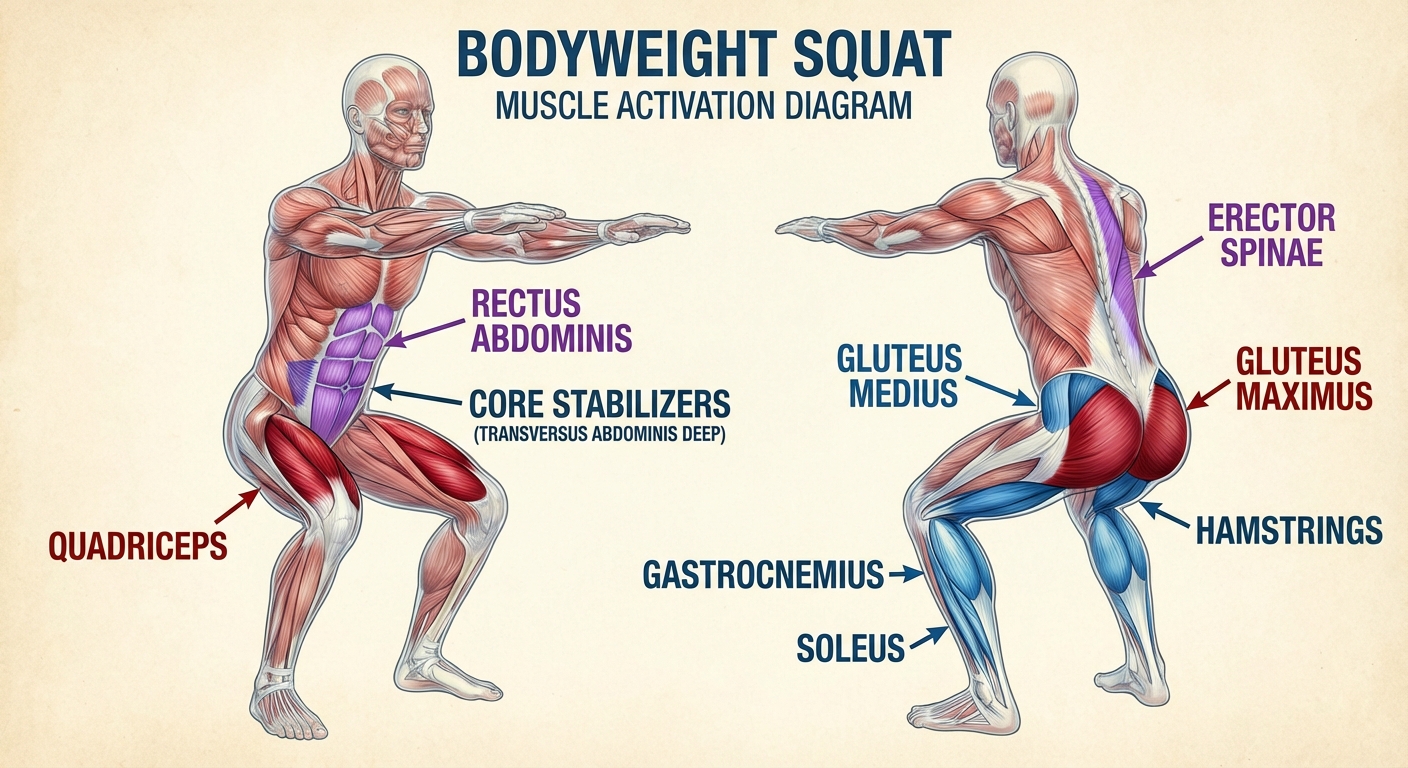
The bodyweight squat is a compound movement engaging a comprehensive network of musculature. Muscles engaged are shown in the diagram above.
Primary Movers
The main engines producing the torque required for triple extension against gravity.
- Quadriceps Femoris – Prime knee extensor.
- Gluteus Maximus – Prime hip extensor.
- Adductor Magnus (posterior fibers) – Assists in hip extension.
Secondary Movers & Synergists
Muscles that assist the primary movers and contribute to the movement pattern.
- Hamstrings – Eccentrically control descent; assist in hip extension.
- Soleus & Gastrocnemius – Control ankle dorsiflexion; contribute to knee flexion/extension.
- Erector Spinae – Maintains upright torso posture.
Stabilizers
Muscles that fixate joints and maintain alignment without producing primary movement.
- Gluteus Medius/Minimus – Pelvis & frontal plane stability.
- Transverse Abdominis, Multifidus – Core & spinal stabilization.
- Intrinsic Foot Muscles – Arch support & balance.
Execution Protocol
Follow this precise, step-by-step protocol to execute the bodyweight squat with optimal biomechanics, safety, and effectiveness. This sequence is designed for integration into a daily warm-up routine.
- Stance Initialization: Stand with feet approximately shoulder-width apart, toes pointed slightly outward (5°–15°). Distribute weight evenly across the entire foot—heel, midfoot, and ball.
- Core & Breath Brace: Inhale deeply into the diaphragm, then brace the core as if preparing for a gentle punch to the abdomen. Maintain this intra-abdominal pressure throughout the movement.
- Hinge Initiation: Initiate the descent by simultaneously pushing the hips back and bending the knees. Imagine sitting back into a chair. Keep the chest up and spine in a neutral alignment.
- Controlled Descent: Lower yourself under control until the hip crease is at or below the level of the knee (full range of motion). Ensure knees track in line with the direction of your toes, preventing valgus collapse.
- Depth & Reversal: Pause momentarily at the bottom position without relaxing the core. Do not bounce. Begin the ascent by driving your feet firmly into the ground.
- Triple Extension Ascent: Extend the hips, knees, and ankles simultaneously. Focus on driving the hips forward and up. Keep the torso-to-shin angle consistent.
- Full Lockout & Reset: Return to the starting standing position, fully extending the hips and knees. Exhale at the top. Reset your breath and core brace before the next repetition.
Common Technique Mistakes & Corrections
| Mistake | Biomechanical Consequence | Coach's Correction |
|---|---|---|
| Knee Valgus (Collapse Inward) | Increases medial knee joint shear stress and strain on the ACL and MCL. Indicates weak hip abductors/external rotators. | "Spread the floor" with your feet. Actively push knees outward during the entire movement. Strengthen gluteus medius with banded clamshells. |
| Excessive Forward Torso Lean | Shifts load to the posterior chain and lumbar spine, reducing quadriceps engagement and increasing spinal shear forces. | "Chest up, eyes forward." Initiate with the hips, not by bending forward. Practice goblet squats to learn upright posture. |
| Heels Lifting Off Ground | Indicates poor ankle dorsiflexion mobility or improper weight distribution. Reduces stability and power transfer. | Consciously keep weight over midfoot/heel. Perform ankle mobility drills (knee-over-toe stretches). Elevate heels slightly on a small plate if necessary for mobility. |
| Lumbar Flexion ("Butt Wink") | At depth, the pelvis posteriorly tilts, causing the lumbar spine to flex under load. This places intervertebral discs at risk. | Maintain a braced, neutral spine. Do not squat deeper than your current hip and ankle mobility allows. Improve hip mobility with deep squat holds. |
| Incomplete Range of Motion | Fails to develop strength and mobility at critical joint angles. Can lead to muscle imbalances and reduced functional carryover. | Aim for hip crease below knee level. Use a box or bench as a tactile target to ensure consistent depth. Prioritize mobility work. |